
I have partnered with The Children’s Book Review and author Dr. Drew Palacio for an interview with Dr. Drew about his newest picture book, Troubles and Doubles and Reflections Askew. Check out the giveaway at the end of the interview for your chance to win a signed copy of two of Dr. Drew Palacio’s books.
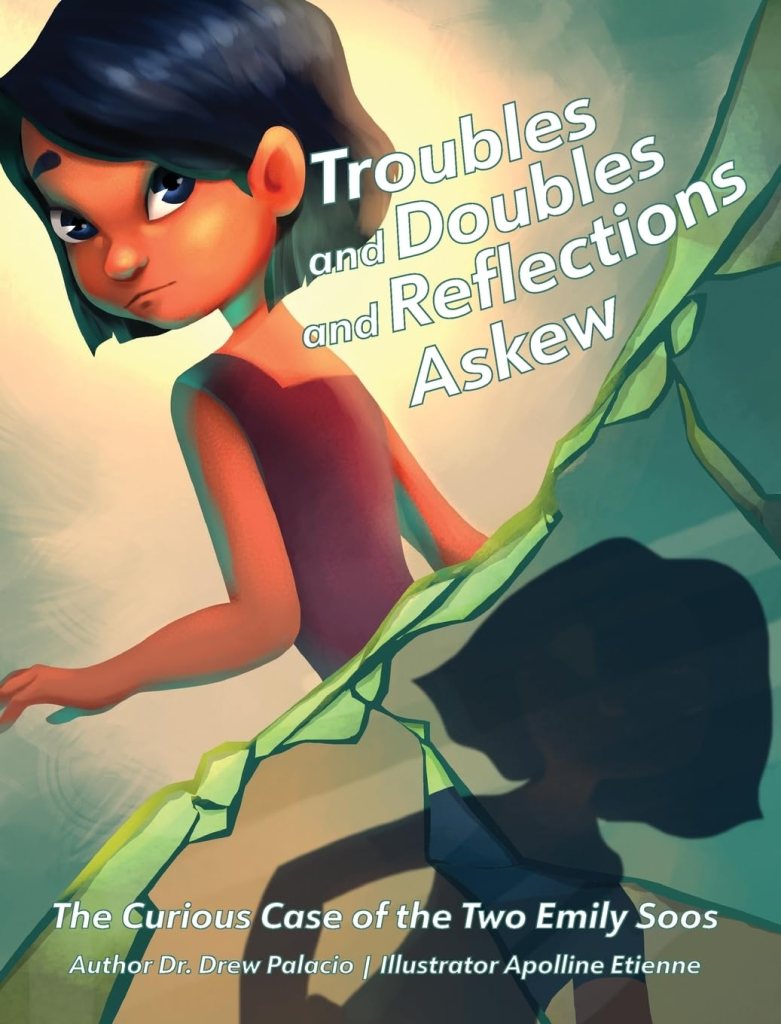
Troubles and Doubles and Reflections Askew
Written by Dr. Drew Palacio
Illustrated by Apolline Etienne
Ages 4+ | 36 Pages
Publisher: Brandylane Publishers, Inc. | ISBN-13: 9781958754368
Publisher’s Book Summary: With a sigh, she went pacing before a large mirror that stood,
Remarking: “Ugh! I’m hideous! None of this looks very good!”
After struggling to find the perfect outfit, Emily Soo dances the night away at a fun party. But when she gets home, her inner voice Emily Two tries to put a damper on her evening.
Confronting our thoughts, fully facing tough emotions, and affirming ourselves can be difficult.
Can Emily Soo find it within herself to squash her Worry and Woe?
Amazon
Bookshop
Barnes and Noble

ABOUT THE AUTHOR
Drew Palacio grew up in Mendocino County, California. He received his doctorate in clinical psychology from the American School of Professional Psychology in San Francisco and currently practices in Kansas. Clinically, he implores partnership and efforts from local families, schools, and the community. Lastly, Dr. Drew is himself a child a heart, using his love of magic and worldly mystery, whether via comic books, animation, video games, or through the passing daydream, to always stoke his inspiration.
INTERVIEW WITH AUTHOR DR. DREW PALACIO:
Tynea: What inspired you to write Troubles and Doubles and Reflections Askew (The Curious Case of the Two Emily Soos)?
Dr. Drew: I admit I never find myself leaping up and thinking, “Oh, I’m going to write about this!” in regard to a particular topic. Instead, it’s something of a different process usually, with an initial image of a character popping into my head and a situation they find themselves in, following which, if I attend to it, a melody of sorts detailing the scene begins to flow.
Amid the writing process, the theme(s) and overall message eventually refines and becomes clear.
I think in speaking to Troubles and Doubles, it’s important to remind that cognition, the processes inherent to how we think, are both sophisticated and nuanced, and is not necessarily an active topic for conversation in families or amid education; nor is ‘how’ exactly cognition plays a part in our esteem, sense of efficacy, moods, or conduct.
There is also the reality that both children and adults may struggle in being “self-monitors,” otherwise meaning being in understanding in these dynamics, and thus knowing that there are ways of persevering and circumventing should our thought processes, moods, and behaviors begin to sour and turn.
Therefore, attempting to create a palpable message underscoring this challenge I believe to be a move in the direction of the greater good.
Tynea: What do you hope people take away from reading your book?
Dr. Drew: I hope people see that there is a relationship between how we think, what we feel, and why we do. And that those experiences, while transient, are interdependent on the hope we have and the kindness and patience we choose to afford for ourselves.
Tynea: You have a doctorate in clinical psychology. How do you incorporate that background into your writing?
Dr. Drew: I think, if anything, it sets the foundation for the types of messages I hope to convey, as my tittles, those being published and to be published, reflect the challenges, founts of confusion, and struggles of young people as observed in my clinical work.
It also affords me the ability to (hopefully) interweave child friendly, though empirical interventions, into the stories resolution; as well as ground me so that I don’t write in such a way that it exceeds the audience’s stage of development.”
Tynea: You have a love for magic and mystery. What is it about those two things that inspire you?
Dr. Drew: I am not so arrogant as to surmise that the exactness of the world is thus known; if it were, and we as a species believed it so, then I argue that we might have exhausted what stories we were left to tell quite long ago.
There is an inherent magic bound to the unknown, and there is a need for our kind, whatever we are, to hold tightly to monsters, myth, and legend. Magic, for the child, helps them understand the world. Magic, for the adult, on the other hand, reminds that the world is still worth turning.
Tynea: If you could give young people one piece of advice, what would it be?
Dr. Drew: I am not sure if this is advice, but what I might say is as thus: “Whether you believe me, or not, you matter, and you’re going to be okay.”

 Heart to Heart